Tuesday, 3 January 2012

Business Leaders as Jazz Band Leaders


The orchestra conductor has often been cited as the perfect metaphor of a leader; the conductor is capable of creating harmony from an enormously complex team. In the army, as well as in business, campaigns are regularly referred to as having to be ‘orchestrated’ to describe the complexity.

Leading The Music - And The Beat Goes On….


The need to manage complexity seems to become more and more important. This pressure is so great that maybe the skills of the jazz leader are now required more than the skills of the classical orchestra leader.


In essence, classical music is ‘old school’, where you know what is going to happen in the end. In jazz, anything can happen, a bit like the modern business environment.


Technically, jazz involves taking a theme, taking it to bits within a rhythmic framework, and putting that back together such that two plus two equals five - you have more than you started with. The great jazz leader has to be thoroughly schooled in the fundamentals, yet possessing an absolute technical competence, and also being able to improvise on a theme. The crucial skill of modern management is this ability to improvise on a theme; this is what separates the classical from the jazz leader.


The ability to improvise is crucial; it is this ability that enables the leader to develop and understand patterns as they unfold. For most leaders there is no real score or script.

The leader is given a theme around which he or she must work and improvise.


The metaphor of jazz is a rich one. You only need to think of some of the great jazz musicians of the later half of the century to see the similarities. Great names such as Duke Ellington, Miles Davis, John Coltrane, Gil Evans, Keith Jarrett, and Stephane Grappelli took traditional themes and ways of working and pushed them to the limit - as with all innovative work, some of it didn’t seem to make so much sense to the ‘mainstream’.


However years of expanding what were originally narrowly defined parameters have opened up new possibilities for the players (and their customers, the audience).


Ellington, Davis, Coltrane and Grappelli can be seen as examples of the expansion of the ‘traditional’ way of doing things; compare them with one of the more innovative modern business leaders, say Tom Peters, classically trained and thoroughly grounded in the fundamentals of their profession.


The Richard Bransons and Anita Roddicks are equally grounded although their learning may not be quite so formal (compare Miles Davis or John Coltrane for the less classically trained jazz players).


Both management and jazz leaders should be great team players (the Dave Brubeck Quartet was together for 16 years). Both types of leader need to be great innovators and have a passion for the success of the team that is only matched by the compassion for the team. Humility is shown in giving credit to the team.


What counts is the leader and his/her ability to take the whole further, beyond existing, safe boundaries; to continuously improvise and to continuously learn. To learn you have to make mistakes, but the key is to learn from those mistakes.


Management-speak and jazz-speak do merge. The role of the leader is to achieve the task - after all this is why the group exists. The other main role is to maintain effective relationships.


Management and jazz leaders are committed to achieving results through people. Their main objectives will be to:

· Gain the commitment and the co-operation of the team;

· Get the group into action to achieve some kind of agreed objectives; and

· Make the best use of the skills, energies and talents of the team.


Successful leaders need to harness and satisfy the needs of the task, the group, and the individuals to be successful.


Case Study A lovely example of the difference between (visionary) leadership and (getting things done) management has emerged as some critics suggest that Paul McCartney was in some respects the creative leader of the Beatles rather than John Lennon.


Yoko Ono is quoted as springing to her dead husband’s defence, ‘John did not make the phone calls, he was not on that level as a leader - he was on the level of a spiritual leader…. He was the visionary and that is why the Beatles happened.’


Will future musicologists view Sir Paul as little more than an organiser with a good telephone manner basking in the reflected glory of Lennon’s genius? What a wonderful portrayal of the difference between the leader and the manager! Or rather, the point is that together they were amazingly successful - a successful team needs both sets of skills.


taken from Kick-Start Your Business, 2001

Saturday, 31 December 2011

What should agencies learn from Lady Gaga?


Manu Field in Marketing Insights on May 16, 2011:

I don’t propose to go into whether or not Lady Gaga deserves this level of success based on a dispassionate assessment of her musical talent. However, one thing which surely everyone can agree on is that she (or her handlers) has hit on – and consistently played on the strength of – a winning strategy. She is shamelessly different.

So Manu, where is your tenuous link to what can be learned from this by healthcare communications agencies, you may be thinking. Well, I would say that Lady Gaga is an excellent case study in support of the core thesis of a book that I read a while back called Bright Marketing by Robert Craven...


Read the whole blog at

http://blog.wcgworld.com/2011/05/what-should-healthcare-comms-agencies-learn-from-lady-gaga


Thursday, 22 December 2011

Bank Holiday Homework!!!!


Feeling lethargic before or after your Bank Holiday break? 


Here are 25 things to get you and your business back into shape. Read the following list and commit to follow through on just five of the following ideas as soon as you get back from the bank holiday:


1) Talk to at least five percent more existing/past clients every day

2) Talk to at least five per cent more potential clients every day


3) Find five ways to improve your product/service


4) Find five ways to get more out of your staff


5) Find five ways to get more profit out of your business


6) Find five ways to get more sales


7) Find five ways to improve understanding of how sales and marketing works


8) Find five ways to improve operational efficiency and consistency


9) Find five ways to spread the workload and make the business less dependent on you


10) Find five ways to make money get used more effectively


11) Find five ways to improve financial planning


12) Find five ways to spend more time "on" and less time "in" the business


13) Find five ways to communicate the vision/purpose to the team


14) Find five tasks to finish or dump that have been hanging around


15) Decide five decisions you want to make


16) Focus on five ways to enjoy your social/private life even more


17) Find five ways to maximise your time


18) Find five ways to laugh more


19) Find five ways to congratulate yourself on your successes


20) Find five ways to spend a little more time thinking and a little less time doing, but also…


21) Find five ways to be a bit more spontaneous


22) Find five new connections you want to make


23) Find five big steps you want to make


24) Agree five things you are going to do in the next five hours


25) Agree five of the above list that you are going to do in the next five days!

Tuesday, 20 December 2011

Andrew Ludlam's Maverick Marketing


Andrew Ludlam's Maverick Marketing is a slim book.

His voice and tone is good; he is neither patronising, smug, nor condescending which is a total relief.

He talks to you about your business in a quietly confident tone.


A small volume that shows you "the essential building strategies for extraordinary business growth" is what the cover says.

Certainly, Ludlam does cover key issues and attitudes to business growth. I found myself nodding and grunting in agreement.


He covers key issues and succeeds in keeping his words to the point. No endless waffle which means you can read the book pretty quickly. However only do this if you are prepared to return to start to uncover the value in the book.
Ludlam is spot on when he says that (and I paraphrase poorly) he can only point you in the right direction but you need to do the hard work.

No empty promises of get-rich-quick schemes in sight. Hurray.


The book is a great intro to business growth and the sort of topics that you would need to work on if you were serious about the subject.

It is clearly an intro to the work that he does and gives you an insight into the tools that he uses in his consultancy work.


As ever, take one nugget from the book and it will be worth its weight in gold. This book has plenty of nuggets.

Friday, 16 December 2011

FT Guide to Business Networking - Heather Townsend


Heather Townsend’s FT Guide To Networking gives you exactly what you’d expect from such a prestigious publisher: a thorough and robust introduction to the subject.

Networking is a mystery, a dark art to many, especially to those in professional service firms where people are trained to be brilliant in their job but often do not receive any formal guidance on the necessary softer skills required to grow a practice. (You are meant to pick up the networking thing by osmosis!)


Townsend systematically takes the whole process apart and examines each piece so the beginner or the relative expert can find great nuggets and insights into the networking process (and then apply them).


Her use of the FITTER framework and an opportunity scoring system allow you to apply her ideas, thoughts, and techniques. And the book is full of helpful lists, how-tos, tips, resource lists and summaries.


You can dip into this book where you feel you need a quick update and review or read it from cover-to-cover.


The book is free of the hippy nonsense that is so-often written about the subject. It is a well-researched book littered with real life examples of the ideas and approaches that she recommends.


Like a sex manual, there will be two types of owners of this book: those who shame-facedly hide it from view for fear of being found out... and those who proudly have it on full display. Which one will you be?

Monday, 5 December 2011

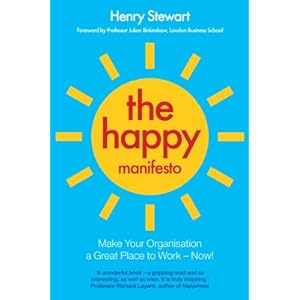
The Happy Manifesto


- The Happy Manifesto - So, to start the review I have to declare that I find most touchey-feeley self-help-type books excruciating to read. I assumed this was just another.


I keep thinking 'show me the numbers' and 'where's the proof?'.


Reading Stewart's book I was like the proverbial dog being dragged on a lead for a walk that they don't want to be part of.


Despite my attempts to challenge and object to Stewart's philosophy I found myself agreeing and supporting his views and I found myself buying into the happy manifesto. So my early prejudices (justified or not) were entirely unfounded.


It is a short book. 120-ish pages.


Its mantra. its ology, its way of looking at the world is deceptively addictive. Like chocolate but for your business brain.


Corporations will find Stewart's arguments almost hypnotic. He gets under your skin.


Not many business books hang around in your thoughts. Not many that you send to your clients. Not many that you want to share.


Of course the book is not perfect but I don't think it intended to be that. What it is... is a springboard, a catalyst, to get you thinking about how you run your business. Not only does he say to you 'Could do better...' but he gives you some very simple starting points....


For me, ideas like pre-authorisation will become part of my business toolkit. Terrific. That one idea is worth its weight in gold.